The Times Literary Supplement - 3 April 2026

The Times Literary Supplement - 3 April 2026
The Times Literary Supplement - 3 April English | 48 pages | | 56.5 MB

For over 120 years, the TLS has been the world's leading weekly international literary paper. The world may have changed, but not the quality of TLS writers. Every week you'll find dozens of reviews and , from to Schopenhauer, theatre to theory. According to Le Monde, the TLS "has no rivals". According to Noam Chomsky, it is "provocative, stimulating, irritating, informative".
To anybody interested in the life of the mind, the TLS is indispensable.

Read more

The Times Literary Supplement - 20 March 2026

The Times Literary Supplement - 20 March 2026
The Times Literary Supplement - 20 March English | 48 pages | | 53.0 MB

For over 120 years, the TLS has been the world's leading weekly international literary paper. The world may have changed, but not the quality of TLS writers. Every week you'll find dozens of reviews and , from to Schopenhauer, theatre to theory. According to Le Monde, the TLS "has no rivals". According to Noam Chomsky, it is "provocative, stimulating, irritating, informative".
To anybody interested in the life of the mind, the TLS is indispensable.

Read more

Vortex Magazine - March 2026

Vortex Magazine - March 2026
Vortex Magazine - March English | 24 pages | | 22.4 MB

Vortex is a monthly magazine which explores the world of , cult thrillers, spy drama and on audio. The magazine covers ongoing audio dramas based on much-loved TV series like Doctor Who, Torchwood, Shadows, Blake's 7, The Avengers, The Prisoner, The Omega Factor, Terrahawks, Captain Scarlet and Survivors, as well as classics such as HG Wells, , Sherlock Holmes, The Phantom of the Opera and Dorian Gray. With regular reviews, exclusive interviews, and much more!

Read more

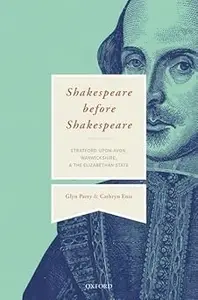
Shakespeare Before Shakespeare Stratford-upon-Avon, Warwickshire, and the Elizabethan State


Free Download Glyn Parry, " Before Shakespeare: Stratford-upon-Avon, Warwickshire, and the Elizabethan State"
English | ISBN: 0198862911 | | 234 pages | PDF | 1457 KB
Before William Shakespeare wrote world-famous plays on the themes of power and turmoil, the Shakespeare family of Stratford-upon-Avon and their neighbors and friends were plagued by false accusations and feuds with the government ― conflicts that shaped Shakespeare's sceptical understanding of the realities of power. This ground-breaking study of the world of the young William Shakespeare in Stratford and Warwickshire discusses many recent archival discoveries to consider three linked families, the Shakespeares, the Dudleys, and the Ardens, and their battles over regional power and government corruption. Robert Dudley, earl of Leicester, and Ambrose Dudley, earl of Warwick, used politics, the , , and lineage to establish their authority in Warwickshire and Stratford, challenging political and social structures and collective in the region. The resistance of Edward ― often claimed as kin to Mary Arden, Shakespeare's mother ― and his friends and family culminated in his execution on false treason charges in 1583. By then the Shakespeare family also had direct experience with the London government's power: in 1569, Exchequer informers, backed by influential politicians at Court, accused John Shakespeare, William's father, of illegal wool- dealing and usury. Despite previous claims that John had resolved these charges by 1572, the book's new sources show the Exchequer's continuing demands forced his withdrawal from Stratford politics by 1577, and undermined his career in the 1580s, when young William first gained an understanding of his father's troubles. At the same time, Edward Arden's condemnation by the Elizabethan regime proved problematic for the Shakespeares' friends and neighbours, the Quineys, who were accused of maintaining connections to the traitorous Ardens ― though Stratford people were convinced of their innocence. This complicated community directly impacted Shakespeare's own perspective on local and national politics and social structures, connecting his early experiences in Stratford and Warwickshire with many of the themes later found in his plays.

Read more

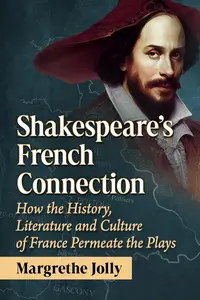
Shakespeare's French Connection How the History, Literature and Culture of France Permeate the Plays


Free Download 's French Connection: How the , and of France Permeate the Plays by Margrethe Jolly
English | 25, | ISBN: 1476695385, 9781476652696 | True | 257 pages | 11.8 MB
Shakespeare most often locates his plays in and England, and his third most frequent setting is France. Indeed, nearly 70 scenes at a conservative count, and perhaps as many as 100, take place in France in a variety of significant geographical locations. French is also the foreign language Shakespeare uses most; he is sufficiently au fait with French to use it for puns and scatological jokes. He weaves in comments on French fashion, ways of walking, and skills in horsemanship, sword-playing and dancing. Not only does Shakespeare draw directly or indirectly upon French chroniclers but he also presents us with parts of French history. Many French characters people his stage; sometimes historical figures appear as themselves, and sometimes they are alluded to. And the plays demonstrate Shakespeare's in French literature and how that influenced him.
Read more

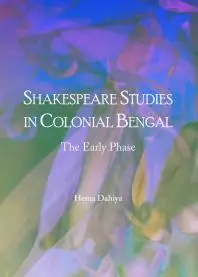
Shakespeare Studies in Colonial Bengal The Early Phase


Free Download Studies in Colonial Bengal : The Phase By Hema Dahiya
2014 | 228 Pages | ISBN: 144386353X | | 1 MB
Shakespeare Studies in Colonial Bengal: The Early Phase represents an important direction in the area of historical research on the role of English education in , particularly with regards to Shakespeare studies at the Hindu College, the first native college of education in Calcutta, the capital of British India during the nineteenth century. Focusing on the developments that led to the introduction of English education in India, Dr Dahiya's book highlights the pioneering role that the eminent Shakespeare teachers at Hindu College, namely Henry Derozio, D.L. Richardson and H.M. Percival, played in accelerating the movement of the Bengal Renaissance. Drawing on available information about colonial Bengal, the book exposes both the angular interpretations of Shakespeare by fanatical scholars on both sides of the divide, and the serious limitations of the present-day reductive theory of postcolonialism, emphasizing how in both cases such interpretations led to distorted readings of Shakespeare. Offering a account of how English education in India came to be introduced in an atmosphere of clashing and conflicting interests emanating from various forces at work in the early nineteenth century, Shakespeare Studies in Colonial Bengal places, in a normative , the part played by each major actor in this highly-contested historical context, including the Christian missionaries, British orientalists, Macaulay's Minute, the secular duo of Rammohan Roy and David Hare, and, above all, the Shakespeare teachers at Hindu College, the first native institution of European education in India.
Read more