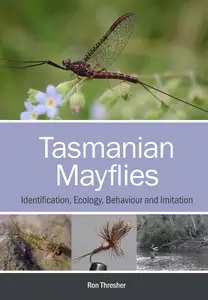
Tasmanian Mayflies Identification, Ecology, Behaviour and Imitation


Free Download Tasmanian Mayflies: Identification, , Behaviour and Imitation by Ron Thresher
English | September 1st, | ISBN: 1486316115 | 228 pages | True | 33.26 MB
Mayflies are one of the world's most diverse, abundant and important aquatic insects. Famous for their brief adult life spans, mayflies play a key role in the ecology of aquatic and associated terrestrial ecosystems, and are bioindicators of ecosystem health.
Read more

Robot Ecology and the Science Fiction Film


Free Download J. P. Telotte, "Robot and the Film "
English | ISBN: 1138598070 | 2018 | 120 pages | | 3 MB
This book offers the first specific application in film studies of what is generally known as ecology theory, shifting attention from to the (in this case media) environment. It takes the robot as its subject because it has attained a status that resonates not only with some of the key concerns of contemporary over the last century, but also with the very nature of film. While the robot has given us a vehicle for exploring issues of gender, , and a variety of forms of otherness, and increasingly for asking questions about the very nature and meaning of life, this image of an being, typically anthropomorphic, also invariably implicates the cinema's own and quite fundamental artificing of the . Looking across genres, across specific media forms, and across closely linked conceptualizations, Telotte sketches a context of interwoven influences and meanings. The result is that this study of the cinematic robot, while mainly focused on science fiction film, also incorporates its appearance in, for example, musicals, cartoons, television, advertising, toys, and .
Read more

Phytoplankton Whispering An Introduction to the Physiology and Ecology of Microalgae


Free Download Patricia M. Glibert, "Phytoplankton Whispering: An Introduction to the Physiology and of Microalgae"
English | ISBN: 303153896X | | 775 pages | | 187 MB
Phytoplankton, or algae, are the engines of the . They form the base of the aquatic food web and, although microscopic, they produce 50% of the oxygen in the air. Many of our of what makes these cells "tick" come from ideas developed decades ago. But, lakes and oceans are changing- and so, too are phytoplankton. Our understanding has to accordingly. Nutrient pollution is a major problem worldwide, and is changing, altering temperature, CO2 and pH, as well as the that control water stratification. All of these factors control which species of phytoplankton may grow well at any particular time. While algae grow in all types of aquatic systems, not all algae are favorable for the production of fish and other food resources. The prevalence of harmful algal blooms (HABs) has increased. At the core of this effort is a drive to understand-and to convey to researchers, students and managers-what kinds of phytoplankton are likely to thrive as conditions change and why this matters.
Read more